
MAIO Implementation Guide 1: The Owner-Led Enterprise (50–200 employees)
Stop running AI experiments. Start running one system. This documents shows you how, with practical guidance, specific automation ideas, risks and things to put off for now.

Over the last two weeks, I’ve published the full MAIO Framework (MAIO = Maximally Automated Intelligent Enterprise): the core document plus all six Stream deep-dives. If you’ve been following along, you now have the complete architectural view of what it takes to turn an organization into a Maximally Automated Intelligent Organization.
Today we shift gears.
Starting now, I’m publishing the Scale-Tier Implementation Guides — four practitioner documents that translate the framework into operational reality for organizations of specific sizes. We start with the smallest of the four, and in many ways the one where this work matters most: the owner-led enterprise, 50 to 200 people.
If you run a company at this scale, here’s the honest picture. AI already exists inside your business. Someone is using ChatGPT to draft client emails. Someone built a Zapier workflow three months ago that nobody documented. Someone raised “AI strategy” at the last leadership meeting and the conversation trailed off. That’s not a strategy. It’s scattered experimentation, and it won’t compound into value.
This guide is the corrective. It shows how to move from scattered AI to a governed system - in 30 days - without hiring a data science team, without buying Fortune-500 software, and without pretending your company is bigger than it is. The operating minimum is deliberately small: one decision from the CEO, one AI Champion with four hours a week, one first AI Spear, one monthly review. That’s it. That’s the system.
If this series has been useful to you, if you’ve saved documents, shared them with colleagues, or used them to start a conversation in your leadership team, I’d be grateful if you’d consider a paid subscription. Every document will remain free to read. Paid subscribers are the reason the work continues.
Now — Use Case 1: The Owner-Led Enterprise….
1. Executive Summary
Most owner-led firms are not short on effort. They are short on system. The owner is the strategic brain, the decision bottleneck, and often the final reviewer for proposals, reports, hiring decisions, problem escalations, and major client communication. The result is predictable: the business grows, but judgment does not scale. Work piles up around the owner. Teams wait. Reporting is slow. Good people spend time on repetitive admin instead of higher-value work.
This guide shows how to fix that without hiring a data science team or buying enterprise software designed for a Fortune 500 company. It adapts the MAIO Framework for owner-led organizations with 50–200 people. In practical terms, that means connecting the systems you already use, identify one high-friction process worth automating first, deploy one AI Spear with clear governance, redesign the affected role so the human keeps the judgment work, and measure whether it actually created value.
Use this guide if you want to do four things in the next 30–90 days:
1. Stop random AI experimentation and put one person in charge of it.
2. Pick the first automation opportunity that is worth doing.
3. Launch it with simple rules that keep you in control.
4. Create a repeatable pattern you can use again.
You do not need a transformation office. You need a decision, an AI Champion, one monthly review meeting, one first AI Spear, and enough discipline to kill what does not work and scale what does.
Read this guide in one sitting. Then start with Section 6: Your First 30 Days.
2. MAIO at Owner-Led Scale: The System Overview
The MAIO Framework is built on three interlocking components: Six Streams (what you work on), Four Phases (when you do it), and a 6×4 Matrix (the operational map). The Six Streams and Four Phases are fixed and universal across all scale tiers. What adapts at Owner-Led scale is the sequencing, tooling, governance weight, and maturity target.
At owner-led scale, do not try to implement the full framework at once. Start with 10–12 Core capabilities, aim for Level 2 maturity in 12–18 months, and treat everything else as deferred. Advanced capabilities (Agent Lifecycle Management, Digital Twins, AI Sovereignty, Knowledge Graphs) should be deferred until Core capabilities reach Level 2+.
These targets assume consistent monthly governance and no major business disruptions. In practice, owner distraction, staff turnover, or economic pressure will slow progress. Plan for Level 2 in 12–18 months as the realistic baseline; celebrate Level 3 as an achievement, not an expectation.
The following matrix shows what each Stream × Phase intersection looks like for an owner-led enterprise:
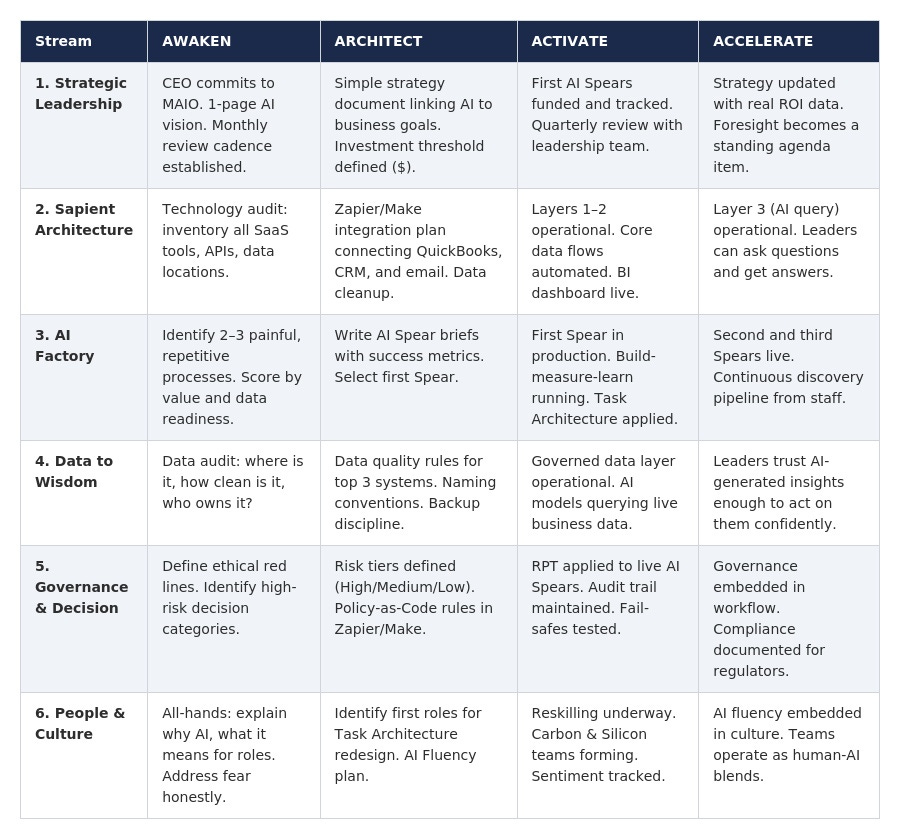
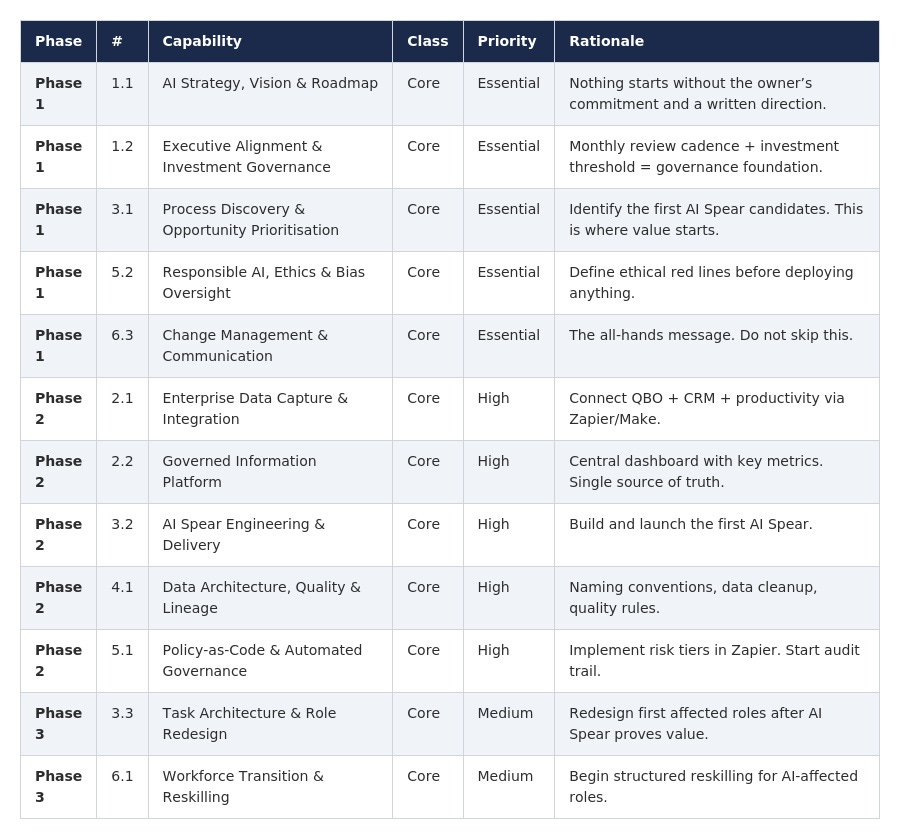
Core capabilities for Year 1 (activate in Phases 1–2): 1.1 AI Strategy, 1.2 Executive Alignment, 2.1 Data Capture & Integration, 2.2 Governed Information Platform, 3.1 Process Discovery, 3.2 AI Spear Engineering, 3.3 Task Architecture, 4.1 Data Architecture & Quality, 5.1 Policy-as-Code, 5.2 Responsible AI & Ethics, 6.1 Workforce Transition, 6.3 Change Management & Communication. | Advanced capabilities to defer (Phase 3–4 or later scale tier): 3.4 Agent Lifecycle Management, 3.5 Physical AI Integration, 4.3 Knowledge Graphs, 4.4 Digital Twins & Simulation, 5.4 AI Sovereignty, 2.5 Edge Computing & IoT.
3. Organizational Profile
3.1 Typical Structure & Decision-Making
The owner-led enterprise is defined by a single structural reality: the owner is the organization. Strategic decisions, major purchases, hiring, client relationships, and operational priorities all flow through one person or a very small leadership group (typically the owner plus 2–4 direct reports covering finance, operations, sales, and delivery). There is no formal board of directors in most cases—or if one exists, it is advisory.
This creates two powerful advantages for MAIO implementation: decisions are fast (no committee approval needed), and the owner can mandate adoption without navigating corporate politics. It also creates two significant risks: the owner becomes the bottleneck (if they are unavailable, transformation stalls), and there is no institutional governance muscle—no compliance team, no internal audit, no formal risk management function.
The typical owner-led enterprise has 1–2 management layers between the CEO and frontline staff. An office manager or operations manager handles day-to-day coordination. Department leads (if they exist) manage 5–15 people each. Communication is informal—Slack messages, hallway conversations, and weekly team meetings rather than formal memos or cascaded communications.
3.2 Typical Technology Landscape
The following table maps the technology stack that the vast majority of 50–200 person organizations have in place today. If you see your own tools reflected here, this guide was written for you.
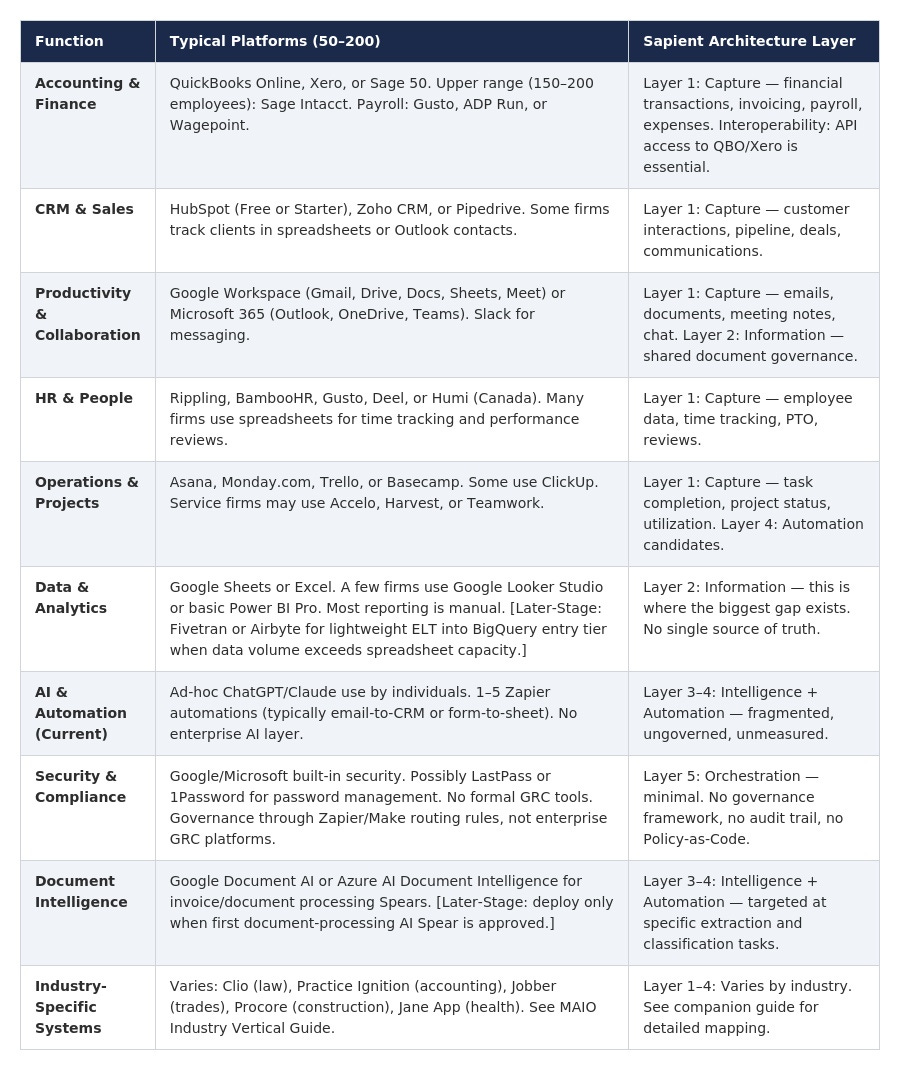
3.3 Budget & Investment Reality
The typical owner-led enterprise spends 3–6% of revenue on technology, most of which goes to SaaS subscriptions, hardware, and MSP support. Total annual IT spend ranges from $150,000 to $750,000, with limited discretionary budget for new initiatives.
A realistic MAIO Phase 1 investment for this scale tier is $5,000–$25,000 over 90 days, covering: AI tool subscriptions (Claude/ChatGPT API: $50–$500/month), integration platform (Zapier/Make: $100–$300/month), a modest BI tool upgrade if needed (Power BI Pro: $10/user/month), and 40–80 hours of internal staff time for discovery, baselining, and the first AI Spear build. This is not a capital expenditure decision—it fits within the owner’s discretionary authority at most firms.
AI FinOps: Proving the Math Before You Scale
Every AI Spear must demonstrate positive ROI through a simple cost-value equation before scaling. If you cannot show the math, do not scale the Spear.
Worked Example — Bookkeeper Invoice Matching:
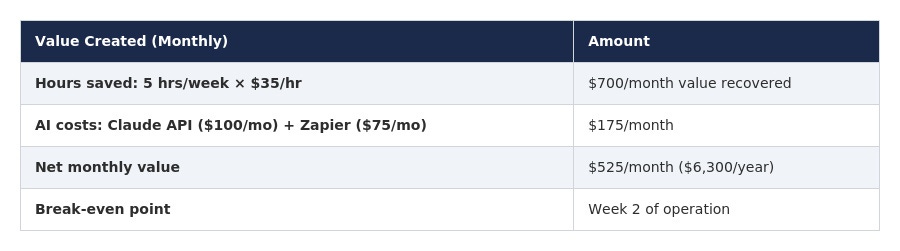
Critical: Value only materializes if freed hours are redirected to higher-value work. Track this with the Capacity-Capture Ratio (CCR). If the bookkeeper spends saved hours on low-value tasks or idle time, the ROI is zero. The CCR measures what percentage of AI-freed time is reinvested in valuable work versus leaked.
Investment governance at this scale is simple: the owner decides. The MAIO Framework recommends formalizing this with a written investment threshold (e.g., “any AI initiative under $10,000 is approved by the CEO; above $10,000 requires a written AI Spear brief with success metric and kill-or-scale threshold”). This is not bureaucracy—it is the discipline that separates strategic automation from impulse purchasing.
3.4 Workforce Composition
A 50–200 person organization typically has 40–60% knowledge workers (admin, finance, sales, management, professional services delivery) and 40–60% operational or frontline staff (technicians, trades, warehouse, customer service), depending on industry. Average technology literacy is moderate—most staff use email, basic Office/Google tools, and 1–2 department-specific applications daily.
Current AI adoption is almost entirely informal: individual employees using ChatGPT or Claude for drafting emails, summarizing documents, or brainstorming—without organizational awareness, governance, or measurement. An estimated 30–50% of knowledge workers are already using AI tools on their personal devices without telling management. This is the “shadow AI” reality that MAIO’s governance framework is designed to address.
The workforce at this scale knows each other personally. Change management is not a formal program, it is a series of conversations. The owner’s visible commitment to AI adoption is the single strongest predictor of success. If the owner uses AI tools daily and talks about it, the team follows. If the owner delegates to “the IT person,” adoption stalls.
4. MAIO Adaptation Map: Six Streams at Owner-Led Scale
These six streams still apply in full at owner-led scale. What changes is how much structure you need, how fast you can move, and how much governance you can realistically carry without slowing yourself down.
4.1 Stream 1: Strategic Leadership & Foresight
MAIO Constructs Applied: Strategic Prerequisite Principle, Investment Governance Principle, Foresight Discipline, Value Architecture, MAIO Steering Committee.
Maturity Staging: Typical starting: Level 0–1. | 12–18 month target: Level 2. | 18–24 month target: Level 2–3. Level 3 is a stretch goal requiring sustained owner commitment and stable operations. | Deferred: AI-driven foresight, predictive funding (Level 4).
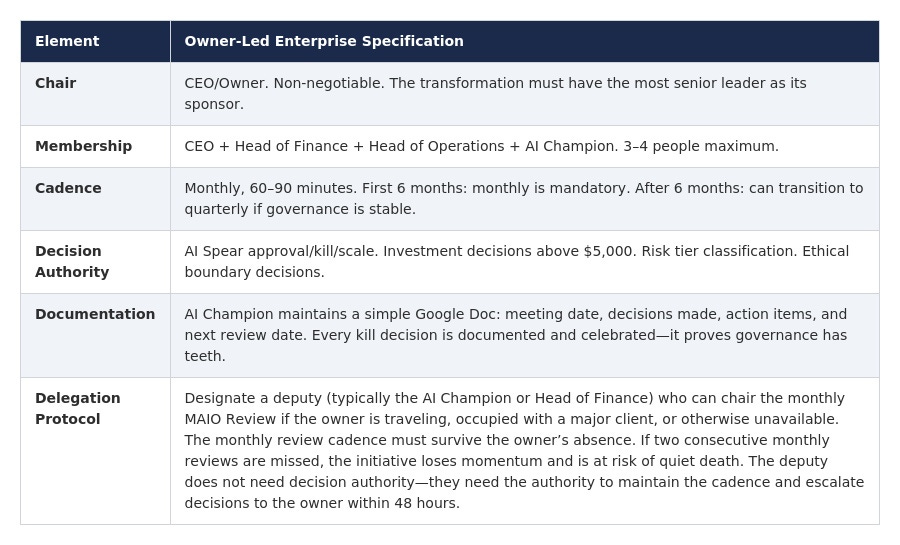
At owner-led scale, the CEO IS the strategic leadership function. There is no separate Strategy Office. The MAIO Steering Committee is the CEO plus 2–3 senior leaders (typically the heads of finance, operations, and sales/delivery) meeting monthly for 60–90 minutes. This meeting replaces or augments the existing leadership meeting—it is not an addition to an already full calendar.
The AI strategy document at this scale is a single page: why we are doing this (competitive pressure, efficiency, talent retention), where we are going (the Sapient Organization vision, simplified), what we are investing (Phase 1 budget), and what we will measure (the first AI Spear’s success metric). Anything longer than one page will not be read.
Foresight at this scale is the CEO reading industry news, attending one AI-focused conference or webinar per quarter, and sharing key insights with the leadership team. It does not require a formal foresight function or scenario planning framework—those are appropriate at Level 3–4 maturity and larger scale.
Technology Enablers for Stream 1
Strategy document: Google Docs or Notion (single page, shared with leadership team).
OKR tracking: Google Sheets with quarterly review cadence.
Investment tracking: simple spreadsheet logging AI spend by initiative.
Foresight: Substack subscriptions (TechTonic Conversations, Stratechery, One Useful Thing by Ethan Mollick), one AI conference per year.
4.2 Stream 2: The Sapient Architecture
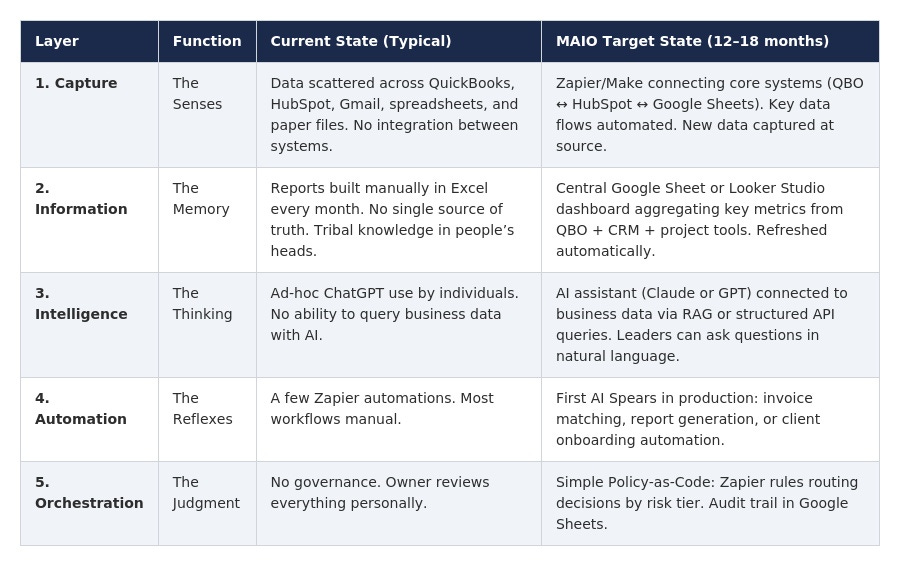
MAIO Constructs Applied: Five-Layer Sapient Architecture (Capture, Information, Intelligence, Automation, Orchestration), Interoperability Principle.
Maturity Staging: Typical starting: Level 0–1. | 12–18 month target: Level 2 (Layers 1–2 operational). | 18–24 month target: Level 2–3 (Layer 3 pilots, Layer 4 first Spears). | Deferred: Full Layer 4–5 integration.
The Sapient Architecture at owner-led scale is built on the tools you already own. You do not need to buy a data lakehouse, deploy Snowflake, or hire a data engineer. You need to connect the systems you already have so data flows instead of sitting in silos.
Technology Enablers for Stream 2
Integration: Zapier (most accessible, $50–$100/month for Team plan) or Make (more powerful, lower cost).
Data hub: Google Sheets for MVP, graduating to Looker Studio or Power BI Pro when ready. [Later-Stage: Fivetran or Airbyte for lightweight ELT into BigQuery or Snowflake entry tier when data volume exceeds spreadsheet capacity.]
AI Intelligence: Anthropic Claude API ($20–$200/month depending on usage) or OpenAI GPT-4 API.
RAG layer: for smaller firms, a simple solution like CustomGPT.ai, Dante AI, or a Google Apps Script connecting Claude to Google Drive.
Automation: Zapier multi-step Zaps, or n8n (self-hosted, free) for technical teams.
Document Intelligence: Google Document AI or Azure AI Document Intelligence for invoice/document extraction Spears.
4.3 Stream 3: The AI Factory
MAIO Constructs Applied: AI Spear, Kill-or-Scale Decision, Task Architecture, Agent Lifecycle Management, AI Spear Brief, Measurement Hierarchy (RPE/EMH/CCR).
Maturity Staging: Typical starting: Level 0. | 12–18 month target: Level 2 (first Spears in production). Level 3 is a stretch goal. | 18–24 month target: Level 2–3 (build-measure-learn running). | Deferred: Agent Lifecycle Management, Physical AI.
At owner-led scale, the AI Factory is not a department—it is a discipline. It is one person (the “AI Champion”) who owns the discovery-build-measure cycle, supported by the owner and the leadership team. The AI Champion is typically the most technically curious person in the organization—often the office manager, a senior analyst, or the IT coordinator. They spend 4–8 hours per week on MAIO activities, not full-time.
Before appointing the AI Champion, remove one existing responsibility from their plate. The Champion cannot do MAIO on top of an already-full job. If the Champion is the Operations Manager, reassign one of their current responsibilities to another team member or defer it for 90 days. The cost of NOT protecting Champion capacity is that the initiative dies quietly in Month 3 when the Champion gets overwhelmed.
The AI Factory produces AI Spears—targeted, time-boxed automation initiatives with pre-committed success metrics. At this scale, run one Spear at a time. Do not attempt to run multiple Spears in parallel until you have successfully completed at least two and established your governance rhythm.
Task Architecture at this scale is a conversation, not a formal HR process. When an AI Spear changes how work gets done, the owner sits down with the affected employee and redesigns their role together. The bookkeeper whose invoice matching is now automated does not lose their job—they shift from data entry to exception handling, vendor relationship management, and financial analysis. The purpose of the role stays the same; the task bundle changes.
Technology Enablers for the AI Factory
AI Spear build tools: Claude API or ChatGPT API for intelligence layer. Zapier/Make/n8n for workflow orchestration. Cursor or Replit for any custom code. Google Forms for intake and feedback.
AI Spear tracking: dedicated Google Sheet with columns for Spear name, status, success metric, current performance, kill-or-scale date. Task Architecture: simple before/after task inventory using a shared Google Doc.
4.4 Stream 4: Data to Wisdom
MAIO Constructs Applied: Data → Information → Intelligence → Wisdom progression, Reasonable Professional Test, ModelOps.
Maturity Staging: Typical starting: Level 0–1. | 12–18 month target: Level 2. | 18–24 month target: Level 2–3. | Deferred: Knowledge Graphs, Digital Twins, Simulation.
The data reality at owner-led scale is simultaneously simple and messy. Simple because there are fewer systems (typically 5–8 SaaS tools). Messy because nobody has governed the data—vendor names are inconsistent across systems, customer records are duplicated, and half the institutional knowledge lives in the owner’s head or in email threads nobody can search.
Data cleanup is the #1 killer of early AI momentum. In most owner-led firms, vendor names are inconsistent, customer records are duplicated, and chart of accounts categories have drifted over years. Budget up to 14 days for cleanup of your first target process, and assign one person to own it. If cleanup exceeds 14 days, pause the Spear—do not start building on dirty data.
The MAIO “Good Enough to Start” principle applies here with full force. You do not need a data warehouse to begin. You need three things: (1) consistent naming conventions in your top 3 systems (QBO, CRM, email), (2) a single Google Sheet that aggregates the 5–7 metrics your leadership team actually looks at, and (3) a weekly 15-minute data quality check by whoever enters data most frequently.
Technology Enablers for Stream 4
Data integration: Zapier/Make pulling data from QBO + CRM + project tools into a central Google Sheet.
Data quality: Google Sheets data validation rules, plus a monthly “data cleanup hour.”
Analytics: Google Looker Studio (free) or Power BI Pro ($10/user/month) for dashboards.
AI intelligence layer: Claude or GPT querying structured data via API.
Document intelligence: Google Document AI or Azure AI Document Intelligence for extraction tasks. AI-powered search over Google Drive/SharePoint using tools like Glean, Guru, or custom RAG solutions.
4.5 Stream 5: Governance & Decision Architecture
MAIO Constructs Applied: Risk-Tiered Reasonable Professional Test (RPT), Liability Routing Principle, Policy-as-Code, Four-Document Governance Chain, AI Sovereignty.
Maturity Staging: Typical starting: Level 0. | 12–18 month target: Level 2. | 18–24 month target: Level 2–3. | Deferred: AI Sovereignty, automated compliance monitoring.
Governance at owner-led scale must be lightweight or it will not survive contact with reality. The owner does not have a compliance team, a legal department, or a risk committee. But governance is not optional—it is what separates intelligent automation from dangerous automation.
The good news: at this scale, governance is personal. The owner can define the rules, enforce them directly, and review exceptions in real time. The Risk-Tiered RPT works beautifully at this scale because the tiers are simple and the reviewer is obvious.
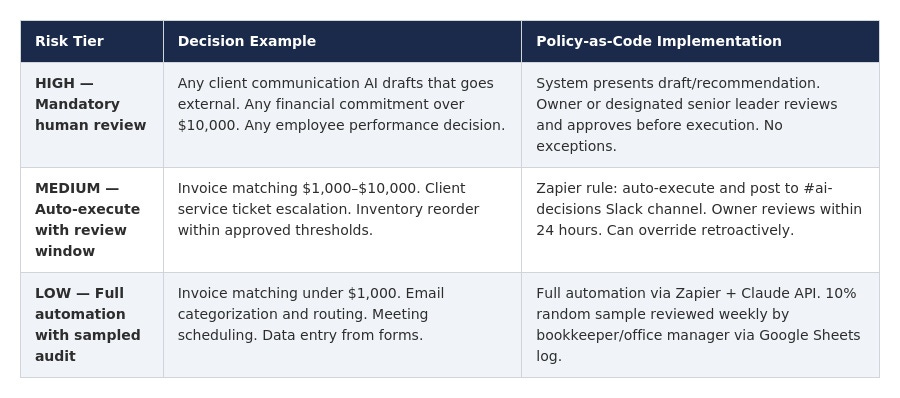
The Liability Routing Principle at owner-led scale is straightforward: the owner is accountable for every AI agent’s behavior. You cannot fire an algorithm, but you can—and will—be held responsible for deploying one without adequate governance. This is why every AI Spear must have a named process owner, and that person must understand their accountability.
Policy-as-Code fail-safe: every automated workflow must have a default fail-safe state. If the AI returns an error, a low-confidence result, or encounters data it cannot process, the default action is always: route to human review. No automated action is taken on uncertain outputs. This is implemented as a simple IF/THEN rule in Zapier: “If confidence < 70% OR error = true, THEN send to owner Slack channel for manual review.”
Technology Enablers for Stream 5
Policy-as-Code: Zapier/Make conditional logic rules (if/then paths based on amount, risk category, confidence score).
Audit trail: dedicated Google Sheet logging every AI decision with timestamp, input, output, risk tier, and reviewer.
Governance dashboard: Google Looker Studio pulling from the audit log.
Ethical red lines: documented in a 1-page “AI Principles” document signed by the owner.
4.6 Stream 6: People, Culture & the Future of Work
MAIO Constructs Applied: Blended Workforce Principle, Carbon & Silicon Teams, Leadership Communication Principle, Task Architecture, AI Fluency Ladder.
Maturity Staging: Typical starting: Level 0–1. | 12–18 month target: Level 2. | 18–24 month target: Level 2–3. | Deferred: Full Carbon-Silicon team operating model, personalized AI reskilling paths.
The Leadership Communication Principle at owner-led scale is a single all-hands meeting, not a cascaded corporate communications program. The owner stands in front of the team and says: “We are investing in AI to make your work better, not to replace you. The repetitive tasks that frustrate you are going to be automated. Your role is being upgraded. We are investing in making sure you are on the right side of this change.”
This message must be delivered by the owner personally—not by email, not by the IT person, not by a consultant. At this scale, authenticity is the only communication strategy that works. If the owner believes it and says it, the team will follow. If the owner delegates the message, the team will assume layoffs are coming.
Carbon & Silicon teams at this scale are informal. When the first AI Spear goes live, the bookkeeper and the AI system form a team: the bookkeeper handles exceptions, validates outputs, and provides the judgment that the AI cannot. That is a Carbon & Silicon team. It does not need a formal charter at this scale—it needs a clear conversation about who does what.
AI Fluency at this scale follows the AI Fluency Ladder: Level 1 (Awareness: everyone attends a 1-hour AI introduction), Level 2 (Literacy: key staff complete a short online course), Level 3 (Competency: the AI Champion can build and manage AI Spears), Level 4 (Mastery: deferred at this scale).
Technology Enablers for Stream 6
AI Fluency: LinkedIn Learning, Coursera, Google AI Essentials certificate (free).
Internal learning: weekly 30-minute “AI exploration hour” where one team member demonstrates a use case.
Change management: direct owner communication + monthly 15-minute AI update at team meeting.
Sentiment tracking: quarterly anonymous Google Forms survey (5 questions: comfort with AI, perceived impact on role, training adequacy, concerns, suggestions).
5. Recommended Capability Activation Sequence
At owner-led scale, activate 12 Core capabilities in a phased sequence. Do not attempt all 30 simultaneously. The following sequence is optimized for maximum early value with minimum governance overhead:
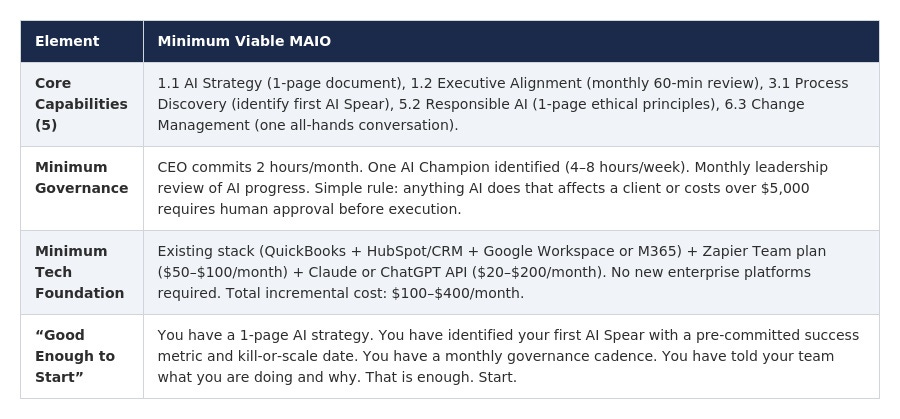
5.1 Minimum Viable MAIO at Owner-Led Scale
If you are overwhelmed by the full framework, start here. This is the absolute minimum to begin your MAIO journey:
6. Phase 1 Quick-Start: Your First 30 Days
This section is designed so a CEO can start tomorrow morning without a consultant.
Before You Start
You need four things:
1. 2 hours per month from the CEO
2. 4–8 hours per week from one AI Champion
3. One shared spreadsheet or Google Doc
4. Permission to start small and learn fast
You do not need a strategy deck, a new platform, or a steering committee charter written by a lawyer.
Week 1: Decide, Assign, Schedule
CEO Actions
By the end of Week 1, do these five things:
1. Make the call. Say, in writing: “We are beginning a structured AI and automation program. We will start with one process, one owner, one success metric, and one monthly review.”
2. Appoint your AI Champion. Pick the most curious, organized, tech-comfortable person in the company. Not necessarily the most senior. Not necessarily IT. Usually operations, finance, admin, or a smart generalist.
Before the Champion starts, remove one existing responsibility from their plate. The Champion cannot do MAIO on top of an already-full job. If you do not protect their time, the initiative dies in Month 3.
Also quietly designate a backup Champion—a second person who shadows the primary Champion’s work and can maintain momentum if the Champion leaves the company, goes on extended leave, or is temporarily reassigned. The backup does not need to be active; they need to be named and aware.
3. Schedule the monthly MAIO Review. Put a recurring 60-minute meeting in the calendar: CEO, AI Champion, Head of Finance, Head of Operations, optional Sales/Client Service lead.
4. Approve the initial tool stack. For most owner-led firms: Claude or ChatGPT, Zapier or Make, Google Sheets or Excel, your existing accounting, CRM, and productivity stack.
5. Tell the team what is happening. Use this message: “We are using AI to remove repetitive work, improve speed, and give people more time for judgment, service, and analysis. We are starting small. No one is being measured by how enthusiastic they sound about AI. We will test one use case, govern it properly, and learn from it.”
Week 1 Deliverables
By Friday, you should have: one named AI Champion, one monthly review meeting scheduled, one approved AI tool list, one company-wide announcement delivered, one shared MAIO working document created. If you have these five things, Week 1 was successful.
Week 2: Find the Best First Use Case
Do not start with the fanciest idea. Start with the most painful process that is: repetitive, digital, measurable, low to medium risk, and owned by someone cooperative.
Ask Each Department Lead These Four Questions
1. What task wastes the most time every week?
2. What task causes the most avoidable errors?
3. What task gets delayed because one person is overloaded?
4. What task already happens in a digital system?
Put every answer into a simple sheet. Score each candidate from 1–5 on: time consumed, error frequency, data readiness, ease of automation, business value if fixed. Add the scores. The highest total is your first AI Spear candidate.
Week 2 Deliverables
By Friday, you should have: a list of 8–15 process candidates, scores for each, a top 3 shortlist, one selected first AI Spear candidate, one named process owner.
If you do not have a clear first Spear by the end of Week 2, you are overthinking it.
Week 3: Scope the First AI Spear
Now write a short Spear brief. Keep it to one page.
Your First AI Spear Brief Must Answer:
What process are we automating? Who owns it? What is the current pain? What system data does it rely on? What tools will we use? What result are we trying to achieve? What is the kill-or-scale threshold? What is the review date? What risk tier applies?
Also do one baseline measurement. Do not build anything yet. First measure the current process for 5 working days: hours spent, number of items processed, number of errors, number of exceptions, who touches the process. This is enough. Do not wait for perfect data.
Week 3 Deliverables
By Friday, you should have: a 1-page AI Spear brief, one baseline measurement, one risk tier, one human review rule, one kill-or-scale date on the calendar.
Week 4: Approve and Launch
This is the decision week.
In the Monthly MAIO Review, Decide:
Is this Spear approved? What is the pilot budget? Who is building it? When does the pilot start? When will we review it? What would make us stop?
CEO rule: If the Spear cannot be explained in five minutes, it is too complicated for a first Spear.
Launch Message to the Team
“We are launching our first AI Spear. It targets one process: [name]. It is owned by [name]. We are testing it for [time period]. Success means [metric]. If it fails, we will stop it. If it works, we will scale it. Human review remains in place for any decision above our defined risk threshold.”
Week 4 Deliverables
By Friday, you should have: one approved AI Spear, one owner, one builder, one budget, one review date, one team communication sent.
What Success Looks Like After 30 Days
At the end of Day 30, you are successful if: the CEO is visibly sponsoring the effort, one AI Champion is operating the process, one AI Spear is approved and underway, one human review rule is active, one metric is being tracked, the team knows why you are doing this. That is enough to begin.
7. AI Spear Candidates for Owner-Led Organizations
The following 10 AI Spear candidates are the highest-value, highest-feasibility automation opportunities for owner-led enterprises at 50–200 employees. They are ordered by typical implementation sequence—start with #1 or #2, not #10.
AI Spear 1: Intelligent Invoice Matching
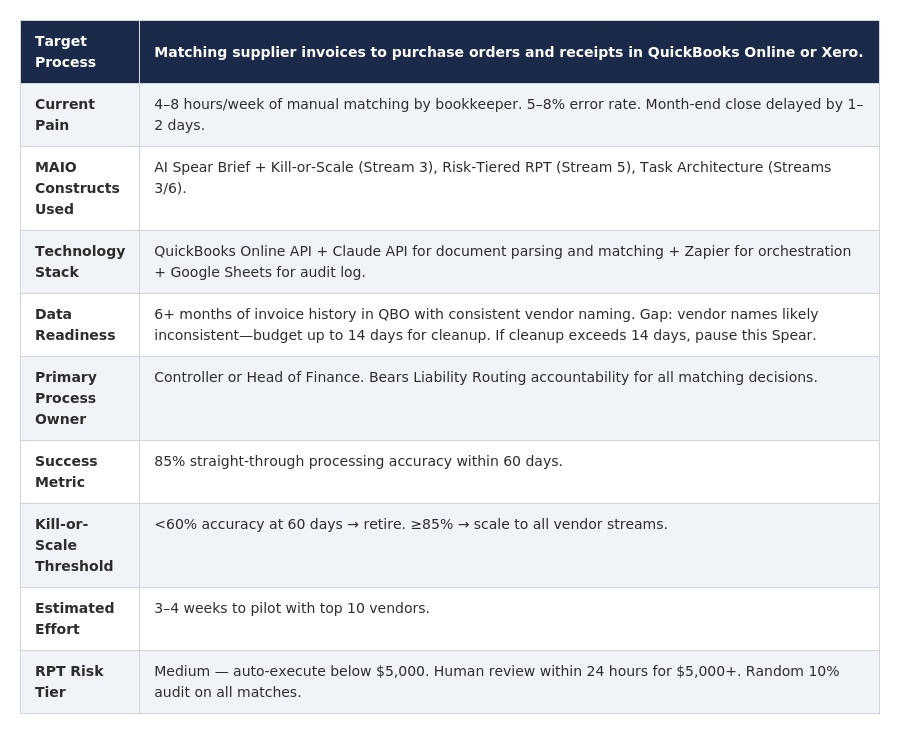
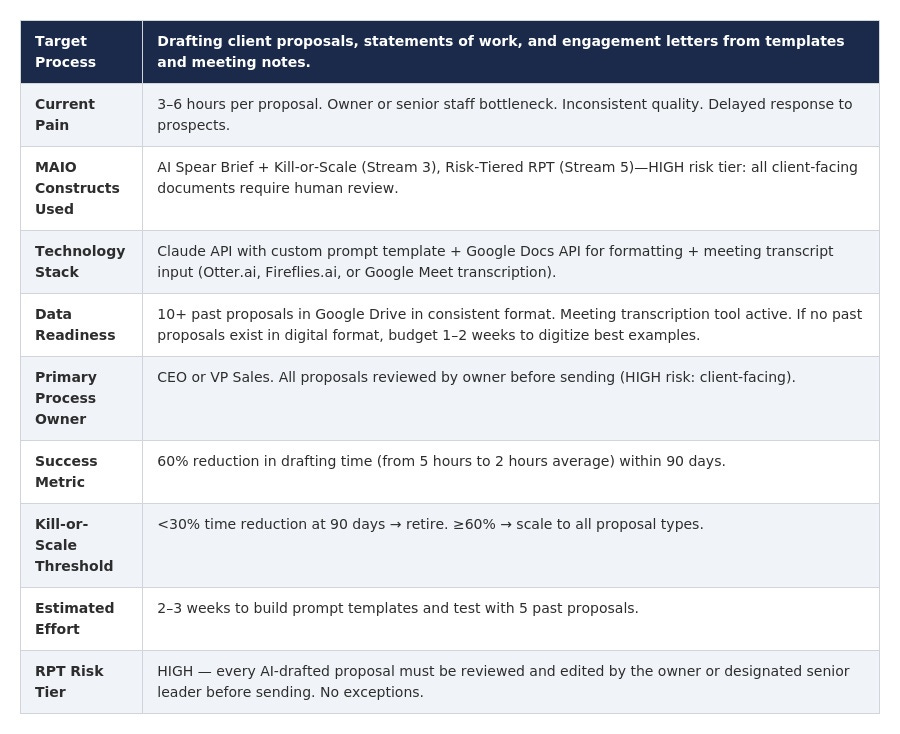
AI Spear 2: AI-Powered Proposal & SOW Drafting
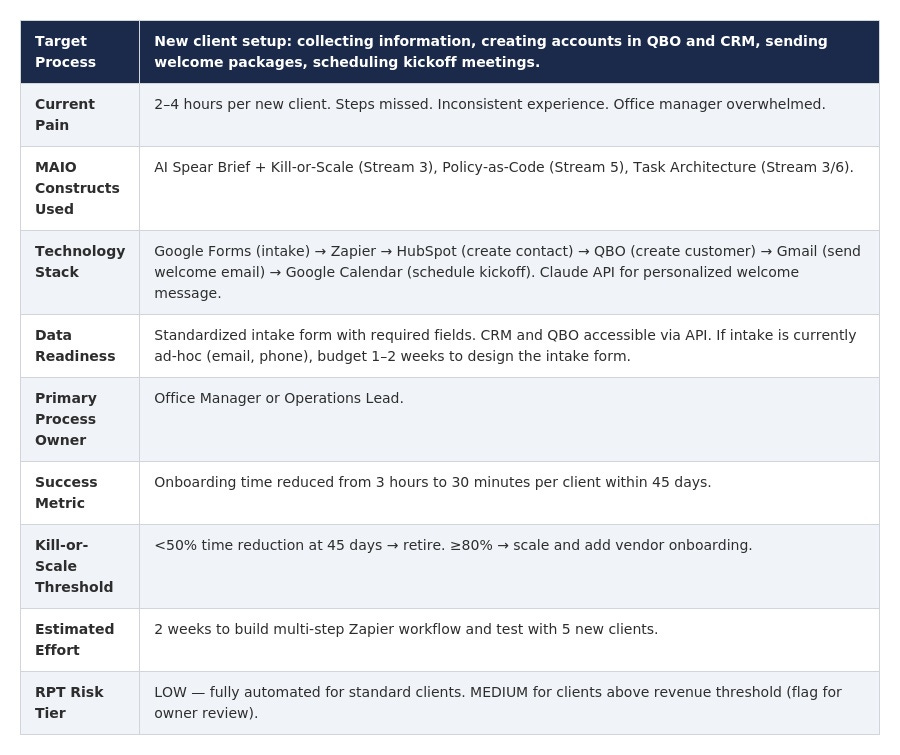
AI Spear 3: Client Onboarding Automation
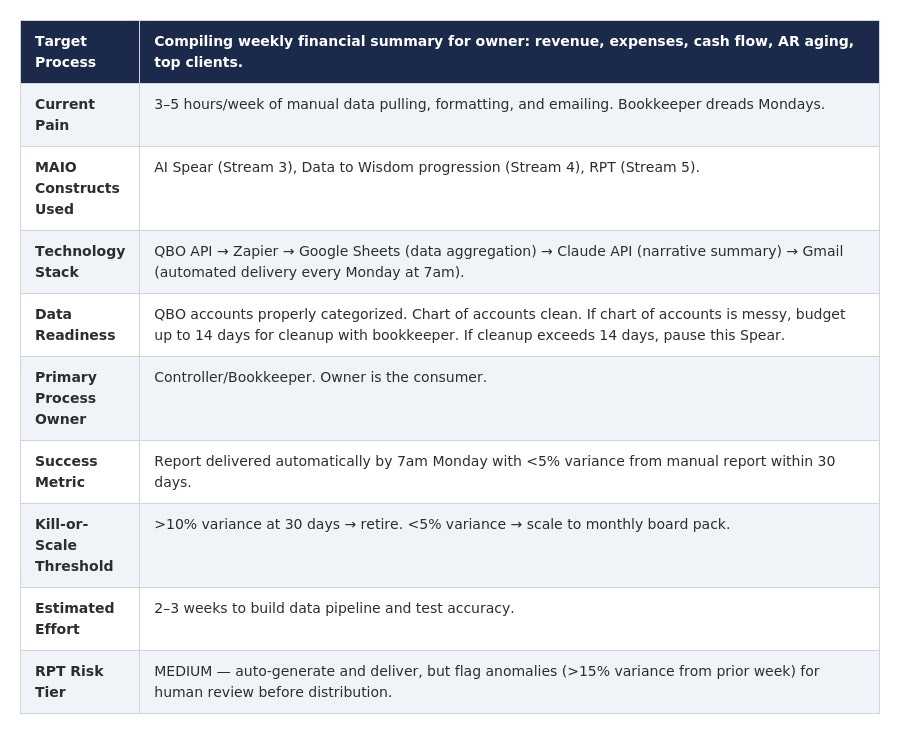
AI Spear 4: Weekly Financial Report Generation
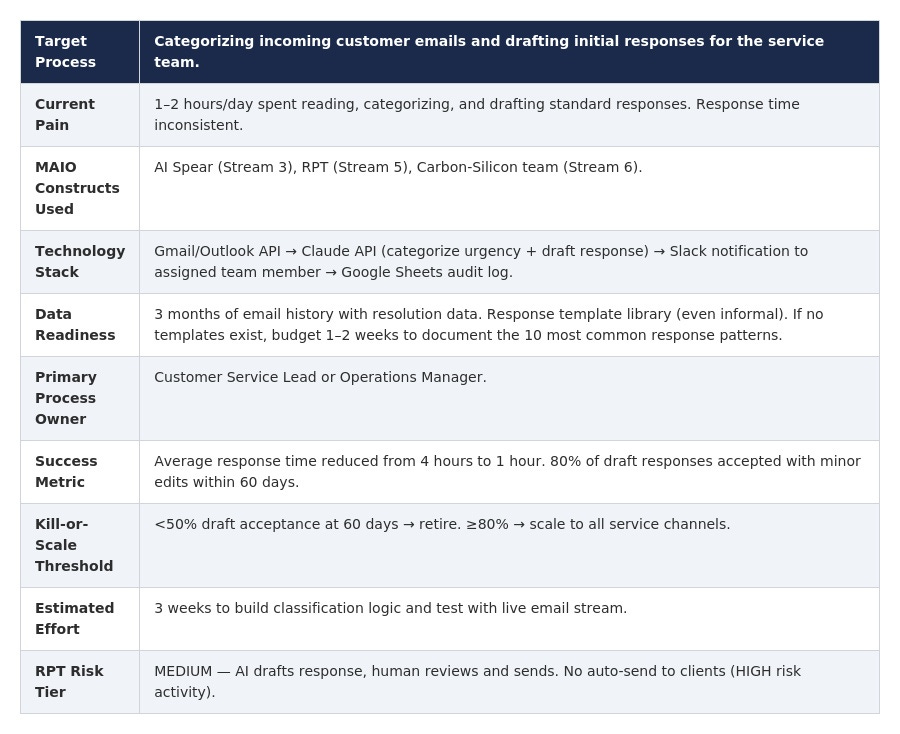
AI Spear 5: Customer Service Email Triage & Draft Response
AI Spears 6–10: Additional Candidates
The following five AI Spear candidates are recommended for Phase 2–3, after the first two or three Spears have been successfully deployed and the governance rhythm is established.
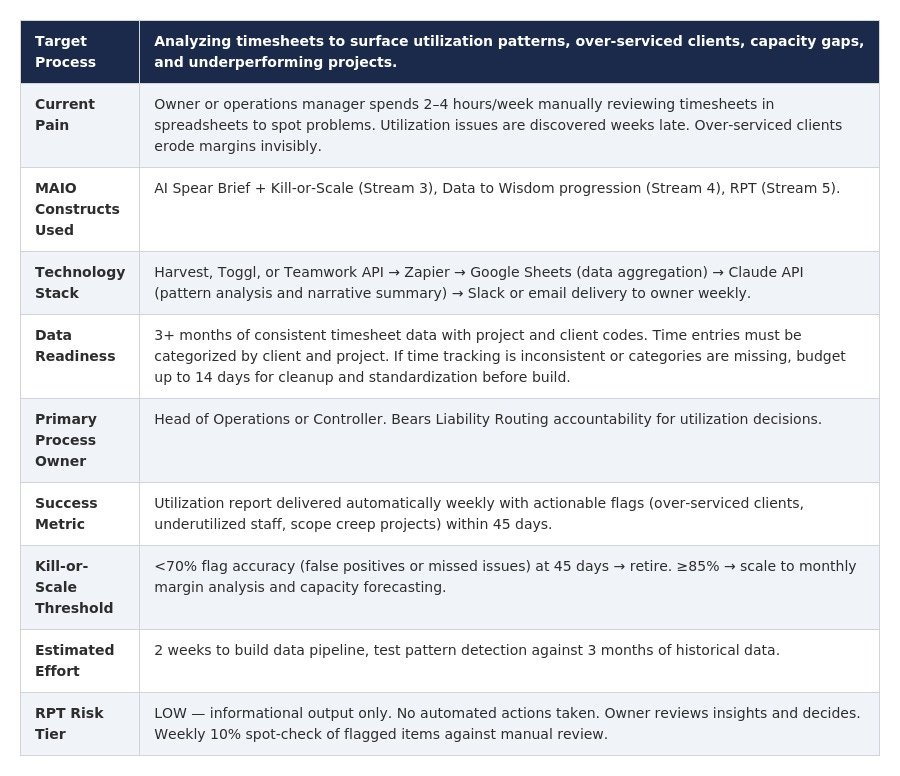
AI Spear 6: Timesheet & Utilization Intelligence
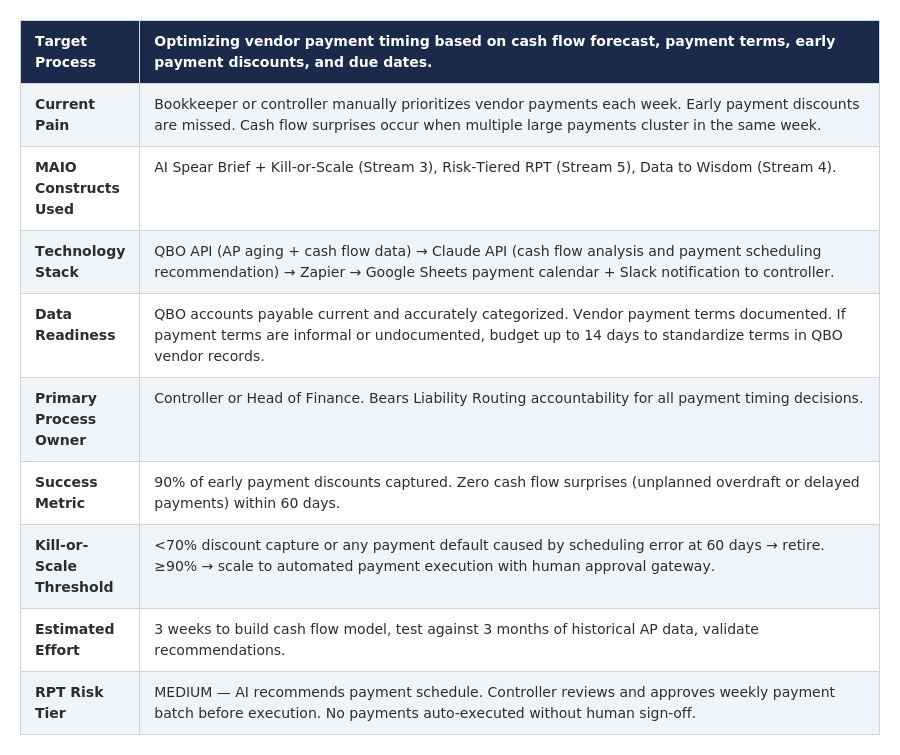
AI Spear 7: Automated Vendor Payment Scheduling
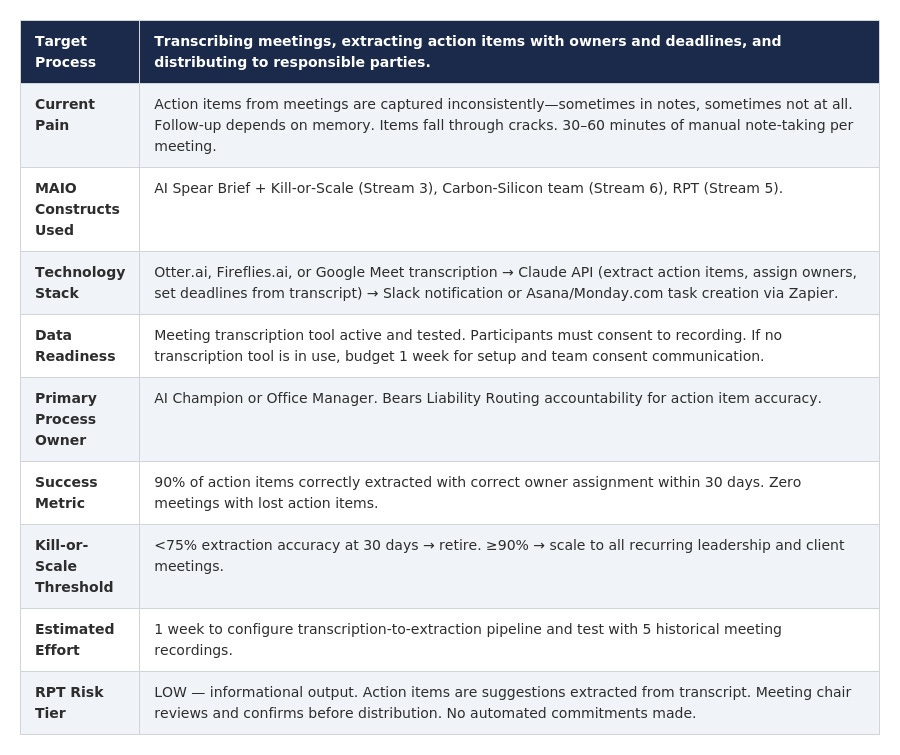
AI Spear 8: Meeting Notes & Action Item Extraction
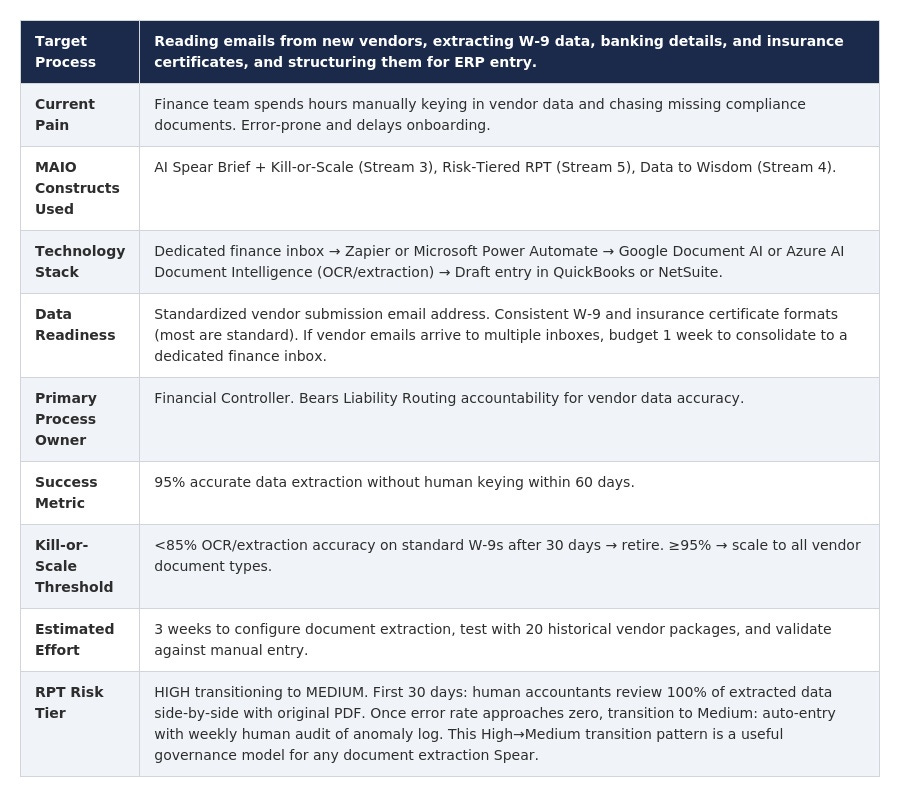
AI Spear 9: Automated Vendor Onboarding & Compliance Extraction
AI Spear 10: Sales Pipeline Intelligence
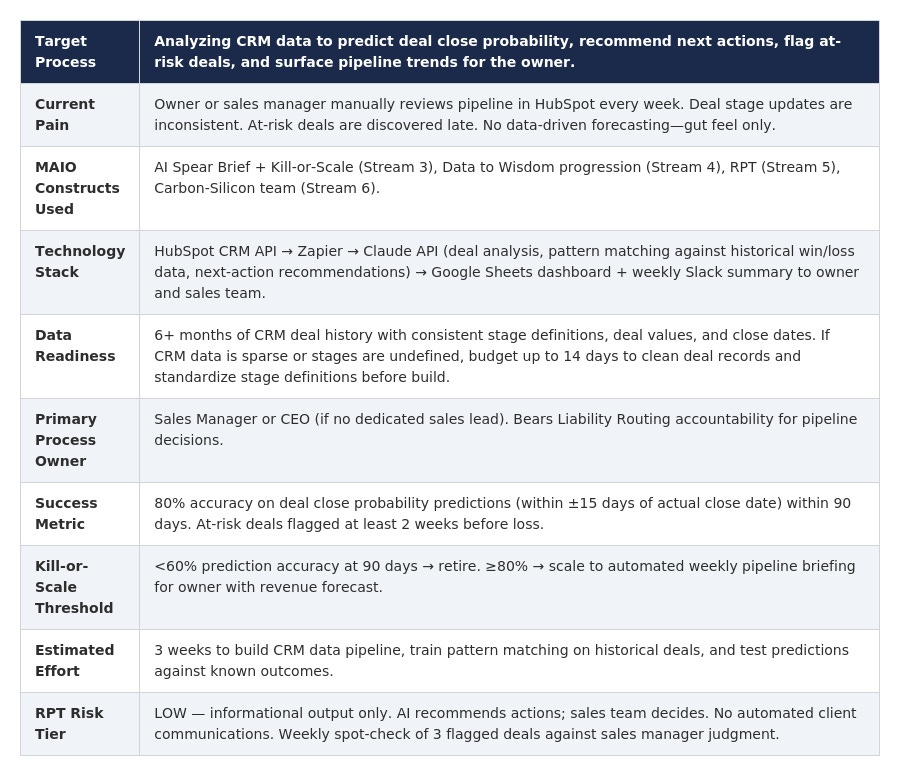
Target Process
Analyzing CRM data to predict deal close probability, recommend next actions, flag at-risk deals, and surface pipeline trends for the owner.
Current Pain
Owner or sales manager manually reviews pipeline in HubSpot every week. Deal stage updates are inconsistent. At-risk deals are discovered late. No data-driven forecasting—gut feel only.
MAIO Constructs Used
AI Spear Brief + Kill-or-Scale (Stream 3), Data to Wisdom progression (Stream 4), RPT (Stream 5), Carbon-Silicon team (Stream 6).
Technology Stack
HubSpot CRM API → Zapier → Claude API (deal analysis, pattern matching against historical win/loss data, next-action recommendations) → Google Sheets dashboard + weekly Slack summary to owner and sales team.
Data Readiness
6+ months of CRM deal history with consistent stage definitions, deal values, and close dates. If CRM data is sparse or stages are undefined, budget up to 14 days to clean deal records and standardize stage definitions before build.
Primary Process Owner
Sales Manager or CEO (if no dedicated sales lead). Bears Liability Routing accountability for pipeline decisions.
Success Metric
80% accuracy on deal close probability predictions (within ±15 days of actual close date) within 90 days. At-risk deals flagged at least 2 weeks before loss.
Kill-or-Scale Threshold
<60% prediction accuracy at 90 days → retire. ≥80% → scale to automated weekly pipeline briefing for owner with revenue forecast.
Estimated Effort
3 weeks to build CRM data pipeline, train pattern matching on historical deals, and test predictions against known outcomes.
RPT Risk Tier
LOW — informational output only. AI recommends actions; sales team decides. No automated client communications. Weekly spot-check of 3 flagged deals against sales manager judgment.
8. Governance Model at Owner-Led Scale
8.1 MAIO Steering Committee Adaptation
8.2 Risk-Tiered RPT with Worked Examples
Refer to the Risk-Tiered RPT table in Section 4.5 above. The three tiers are enforced through Zapier/Make conditional logic and a Google Sheets audit trail. Every AI decision is logged: timestamp, input, output, risk tier, reviewer (if applicable), and outcome.
8.3 Policy-as-Code: Realistic Implementation
At owner-led scale, Policy-as-Code means Zapier IF/THEN rules, not Open Policy Agent. Examples: “IF invoice_amount > $5,000 THEN route to owner Slack channel for review.” “IF customer_email contains complaint keywords THEN classify as HIGH priority and notify operations manager.” “IF AI_confidence_score < 70% THEN hold output and route to human review.”
Fail-safe principle: every automated workflow must have a default fail-safe state. If the Zapier workflow errors, if the Claude API times out, if the data feed is interrupted—the default action is always HOLD AND ROUTE TO HUMAN. No automated action is taken when the system is uncertain or broken. This fail-safe must be the first step built into every Zap, not an afterthought.
8.4 The Liability Routing Principle
At owner-led scale, Liability Routing is simple and personal: the owner is accountable. For each AI Spear, the owner designates a process owner (typically a department lead) who bears operational accountability for the AI agent’s behavior within their domain. The owner retains ultimate accountability for the decision to deploy AI and the governance framework that governs it. This must be stated explicitly when each AI Spear is approved—not implied, stated.
9. Workforce Transition & Carbon-Silicon Teams
9.1 The Leadership Communication Principle
At owner-led scale, there is one message and one messenger. The CEO delivers the following narrative to the entire team in a 30-minute all-hands meeting:
“The nature of valuable work is changing, and we are investing in making sure every person in this room is on the right side of that change. We are adopting AI tools to automate the repetitive tasks that burn your time and energy—the data entry, the report formatting, the invoice matching, the email drafting. Your role is being upgraded, not eliminated. We are investing in your skills because your judgment, your relationships, and your institutional knowledge are irreplaceable. The AI handles the mechanical work. You handle the work that matters.”
Follow this with specifics: what the first AI Spear is, who is affected, what changes in their day-to-day, and how you will measure success. Take questions honestly. Repeat this message at every monthly team meeting for the first 6 months.
9.2 Task Architecture Examples with Governance Link
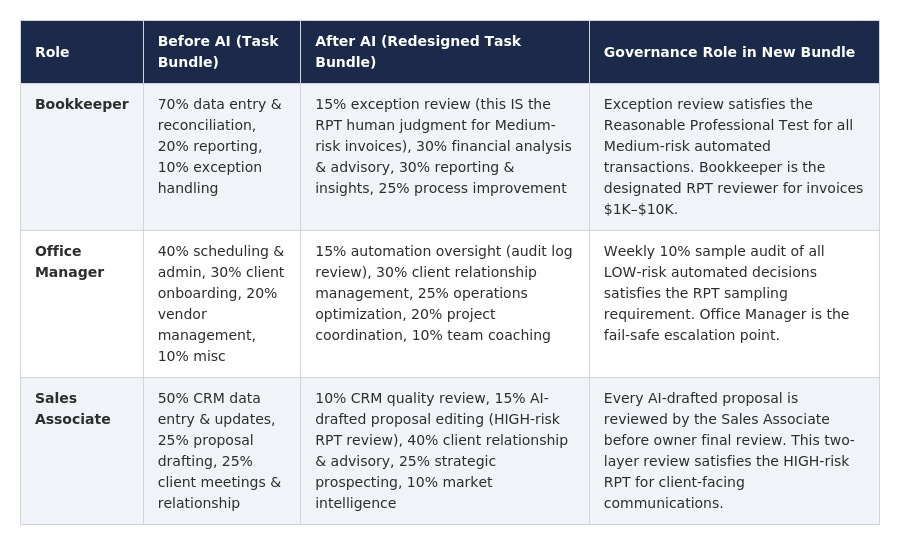
9.3 Reskilling & AI Fluency
AI Fluency Ladder at owner-led scale: Level 1 (Awareness): Every employee attends a 1-hour introduction to AI tools relevant to their role. Delivered by the AI Champion or an external facilitator in Month 1. Level 2 (Literacy): Key staff (bookkeeper, office manager, sales leads) complete Google AI Essentials certificate (free, ~5 hours) or LinkedIn Learning “AI for Business” course within 90 days. Level 3 (Competency): The AI Champion can independently build and manage AI Spears using Claude/GPT API + Zapier within 6 months. Level 4 (Mastery): Deferred at this scale until Phase 3–4.
Practical mechanism: establish a weekly 30-minute “AI Exploration Hour” where one team member demonstrates an AI use case they discovered. Rotate the presenter. This builds cultural fluency without formal training overhead.
10. Common Pitfalls at Owner-Led Scale
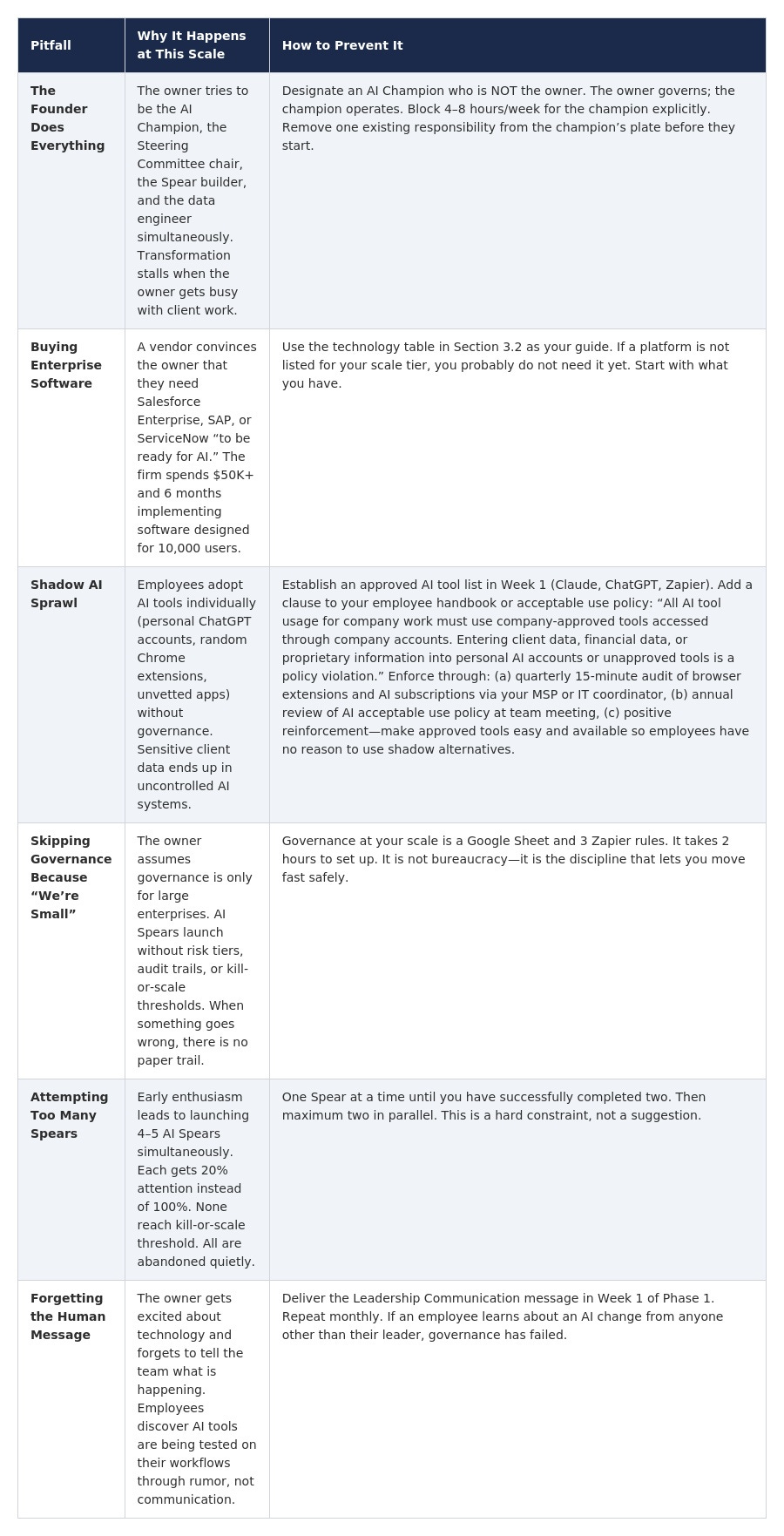
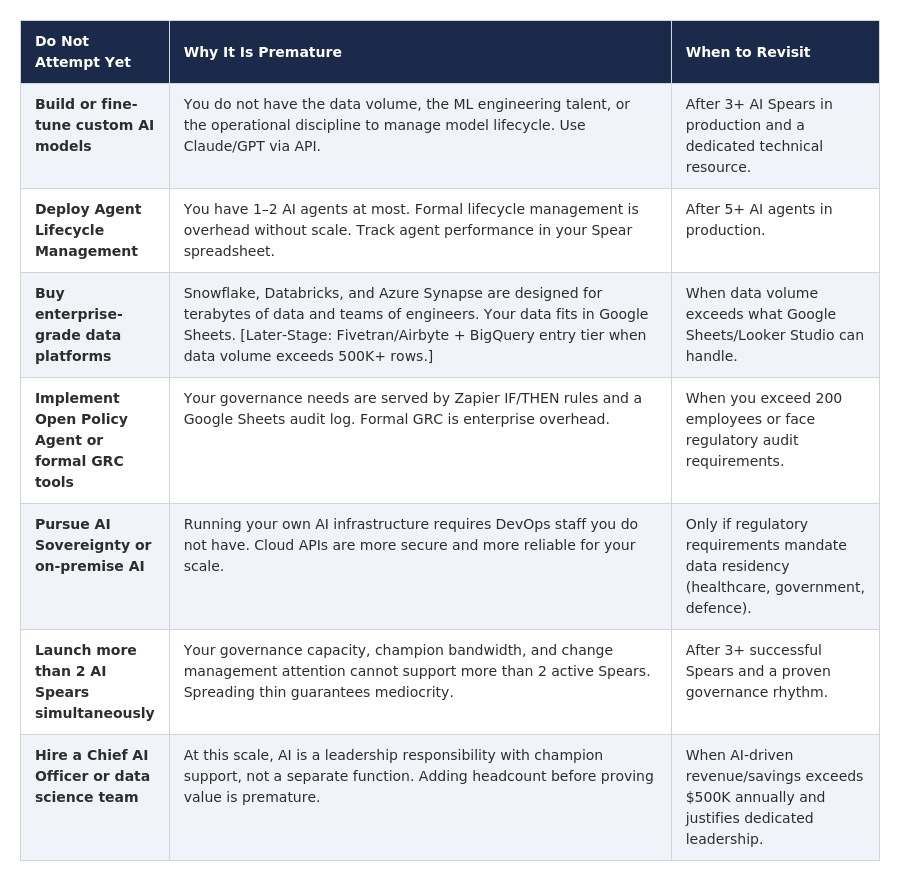
10.1 Not Yet: What to Defer at Owner-Led Scale
The following initiatives are valuable but premature for a 50–200 person organization in the first 18 months of the MAIO journey. Attempting them too early will consume resources, distract from Core capabilities, and likely fail:
11. In Practice: An Owner-Led MAIO Journey
Prairie Mechanical Services is a 120-person HVAC and mechanical contractor serving commercial buildings across Alberta and Saskatchewan. The owner, a second-generation trades operator who took over from his father in 2014, runs the firm with a leadership team of four: a VP of Operations, a Controller, a Sales Manager, and a Service Coordinator. Annual revenue is $22 million. The firm uses QuickBooks Online, Jobber for field service management, HubSpot CRM (Starter), and Google Workspace. Before MAIO, three employees were using AI without anyone knowing—a project manager used ChatGPT to clean up client emails, a service coordinator built three Zapier automations nobody documented, and an estimator was pasting old scopes of work into Claude to speed up quoting. None of this was governed. None of it was measured. None of it compounded.
The MAIO Capability Assessment scored the firm at Level 0–1 across all six streams: no AI strategy, no data integration, no governance, no reskilling plan, and fragmented shadow AI. The owner recognized the urgency after two events: losing a major quoting competition because their proposal took four days while a competitor delivered in 24 hours, and discovering that an estimator had pasted a client’s confidential building specifications into a personal ChatGPT account.
The owner decided to stop calling it experimentation and start treating it like a system.
Phase 1 launched in Week 1 with the owner committing to a monthly MAIO review and designating the VP of Operations as AI Champion (6 hours/week). To protect the VP’s capacity, the owner reassigned weekly safety meeting coordination to the Service Coordinator for 90 days. The pain point inventory surfaced two obvious candidates: proposal and scope drafting (the owner’s biggest bottleneck—he personally reviewed every major quote) and service ticket triage (the service coordinator was buried in overlapping job requests). Proposal drafting won because it was slower, more expensive, and more owner-dependent. The average quote took 3.5 hours to assemble, review, revise, and send. The pilot goal was simple: cut proposal drafting time in half without increasing scope or pricing errors.
The AI Spear was built in 3 weeks: Claude API connected to a library of 40 past scopes and proposals in Google Drive, with a structured prompt template that pulled in project specifications, site conditions, and pricing history. The estimator entered project details into a Google Form; Claude generated a draft scope and pricing summary; the estimator reviewed, edited, and forwarded to the owner for final approval. The success metric was 50% reduction in drafting time.
The governance tension came in Month 2. The AI system generated a scope for a retrofit project that omitted an asbestos exclusion clause—a standard site condition that any experienced estimator would include. The estimator caught it in review before it reached the owner, but it was close. The owner used this as a teachable moment: the governance rule was reinforced (every AI-drafted scope must be reviewed against the firm’s mandatory exclusion checklist before owner sign-off), a fail-safe was added to the prompt template (“Always include all applicable site condition exclusions from the master exclusion list”), and the incident was logged in the audit trail. This near-miss actually strengthened the team’s confidence in the governance system—it proved the human review layer worked.
The workforce tension emerged from the senior estimator, who had 22 years of experience and felt the AI was “juniorizing” the role. He said: “I didn’t spend two decades learning mechanical systems so a chatbot could write my scopes.” The owner addressed this directly: “The AI drafts the scope. You provide the judgment about site conditions, equipment selection, pricing risk, and client relationship. That judgment is more valuable now, not less, because the drafting time is gone and you can focus entirely on what requires expertise.” The estimator became an advocate after seeing his quoting throughput double while his error rate dropped.
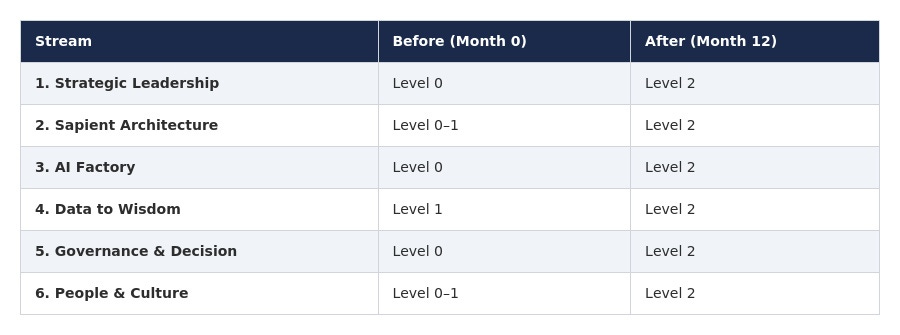
At 12 months, Prairie Mechanical had three AI Spears in production (scope drafting, service ticket triage, weekly financial reporting), had redesigned three roles using Task Architecture, and had moved from MAIO Level 0 to Level 2 across Core capabilities. Quoting time dropped from 3.5 hours to 1.2 hours—65% reduction. Invoice exceptions decreased by 40%. The owner regained approximately 6 hours per week previously spent reviewing routine quotes.
Revenue per employee improved from $183,000 to $194,000 over the 12-month period. However, only 4–6% of that improvement is isolatable to AI efficiency based on Capacity-Capture Ratio analysis. The remainder reflects pricing increases, a favorable project mix, and two large new contracts. Year 1 RPE improvement of 3–6% is a realistic expectation for firms at this scale. 10% RPE improvement is a stretch goal achievable only with sustained governance and deliberate capacity reallocation over 18–24 months.
Employee sentiment (measured quarterly) showed 72% positive AI sentiment at 12 months, up from 38% at baseline.
What Prairie Mechanical deferred: custom AI model training, Agent Lifecycle Management, formal data warehouse, external AI governance certification, and Knowledge Graph development. These remain on the Phase 4 roadmap for Year 2–3.
Before/After Maturity Snapshot
12. Measurement Framework at Owner-Led Scale
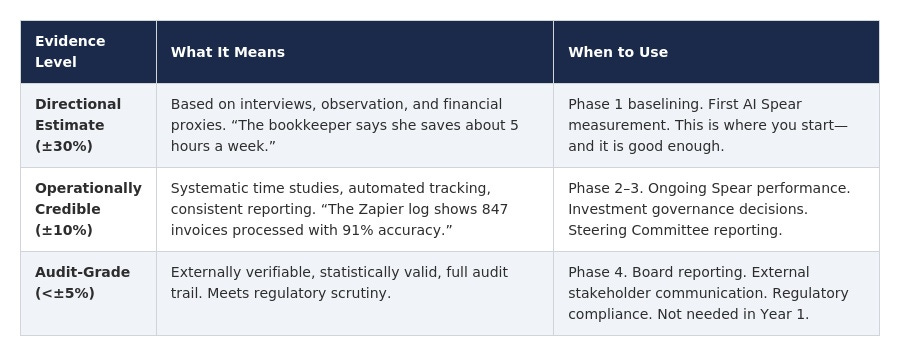
Measurement at owner-led scale follows the “Good Enough to Start” principle. You do not need enterprise analytics to begin. You need honest numbers that tell you whether the needle moved.
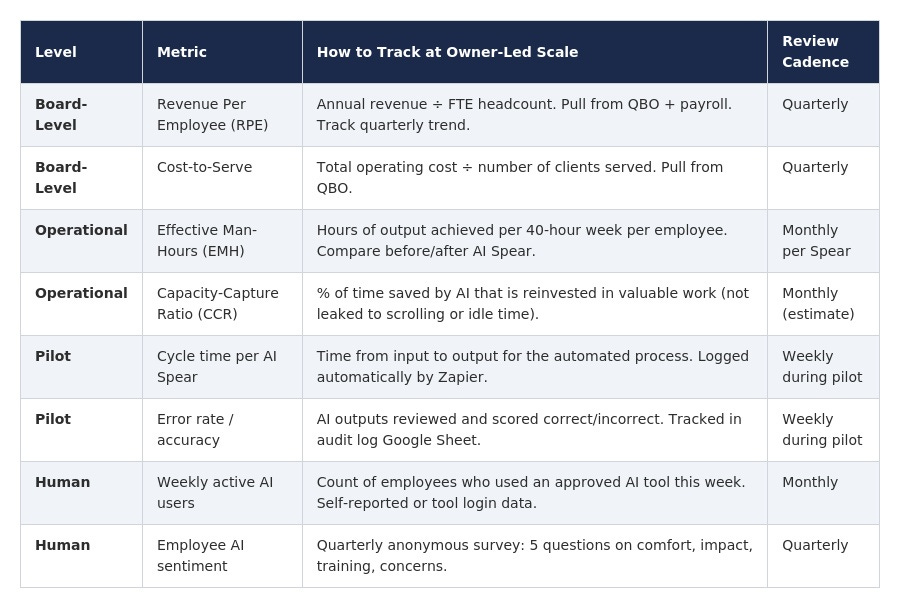
The MAIO measurement hierarchy adapted for owner-led scale:
13. Begin
You now have everything you need to start. Not everything you need to finish—that will take 18–24 months of disciplined, governed, human-led transformation. But everything you need to start: a strategy framework, a technology map, a governance model, ten AI Spear candidates, a 30-day action plan, a measurement system, a list of what not to do, and a case study showing what this looks like in practice.
Most 50–200 person organizations today are in the Bolt-On AI stage: scattered experiments that never compound. The MAIO journey transforms this into a governed, deliberate path toward the Sapient Organization—an entity with a digital nervous system you can converse with, governed by your judgment at every consequential decision point.
You do not need a transformation office, a big software purchase, or a six-month planning cycle. You need one decision, one champion, one first Spear, and the discipline to measure whether it worked.
MAIO provides the system. This guide provides the translation for your scale. The next step is Phase 1, Week 1: secure your commitment, identify your AI Champion, and begin.
Use this guide alongside the core MAIO Framework document and the relevant Stream deep-dives (Streams 1–6). If your organization operates in a specific industry, layer in the companion MAIO Industry Vertical Guide for your sector.
To begin your MAIO journey, contact The Summit Leadership Alliance.
greetings@thesummitla.com
techtonicconvos.substack.com
Regulatory Disclaimer: MAIO’s governance architecture is designed for alignment with the EU AI Act, NIST AI RMF, and ISO/IEC 42001. Detailed regulatory crosswalks are provided in Stream 5: Governance & Decision Architecture (Sections 7.3–7.5). Legal compliance requires jurisdictional interpretation by qualified legal counsel. MAIO facilitates compliance readiness; it does not constitute legal advice.
© 2026 The Summit Leadership Alliance. MAIO is an open-source framework. This document may be used, adapted, and redistributed with attribution.
A great combinator of thoughts. Clearly thought out.